Showing posts with label movies. Show all posts

Tuesday, February 7, 2012

Hear me out... Movie Adaptations

I have a fondness for movie adaptations that make fantastical or cartoonish source material "work" by adding darker, more "realistic" elements.

The two prime examples I can think of are Bryan Singer's X-Men movies:


And Super Mario Bros. The Movie:


(stay with me...)


Now, that doesn't mean I don't love a good 100% faithful adaptation -- I do! Sin City, 300, the (first two) Spider-Man movies, even the recent Marvel-produced movies are largely, with only slight exceptions (or in some cases, none at all), committing the comics page to screen, and I love that!

But, I also love the idea of breaking things down to what they are at their core.

For example, my favorite of the Punisher movies (relative to each other) is the first one, because it felt like what the Punisher would really be like in the real world. He's not a dude in black spandex and a skull logo spouting poetic verse about how the guilty must be punished, he's a dirty, greasy, disturbed, dead-eyed headcase who lives in the sewers and only comes up to murder criminals.


(while spouting poetic verse about how the guilty must be punished)


•

•

•


(technically, my favorite Punisher movie is Man on Fire...)

(...but that's neither here nor there.)


•

•

•


"What would the X-Men be like if they existed in the real world?"

Well, they wouldn't be brightly colored superheroes beating up supervillains, they'd be a paramilitary force dressed for combat, fighting a secret war against a ragtag group of terrorists.

Because, here's the thing... when I look at a comic -- and primarily, I'm talking about superhero comics here -- I'm seeing the real world cast through a fantastical lens. And I enjoy it! It stimulates the imagination to contrast these things against what I know to be true.

So, conversely, taking the fantastical and casting it through a realistic lens has much the same effect. It's taking one thing and shaping it into a different kind of thing, while still keeping what made the original thing distinctive.

And it's the same for Super Mario Bros!


"What would Super Mario Bros. be like if it existed in the real world?"


(and I love this part)


"It would be FUCKING BLADE RUNNER!!!"


Citizen Kane Clap

Of course it would!

Seriously, what an act of sheer invention. To take this nonsensical world of castles and mushrooms and evil dragon/turtle/monster kings and heroic plumbers, and turn it into a gritty cyberpunk dystopia where the meteorite that supposedly killed the dinosaurs actually split the Earth into two parallel dimensions and oh fuck it, just let the movie explain.

I can honestly say that a 100% faithful adaptation of the game to live action would not have been anywhere near as interesting as the film that was made. Yet it still had all the little elements that made it distinctly Mario Bros. They were representations and approximations, but they were there. It felt like this crazy little Elseworlds version of the video game.

And that's really the point, I guess. Movies can be that, because they'll never be the original thing. And sometimes it's better to invent (or reinvent) rather than adapt, because ultimately, all the latter means is that you're being told a story you already know -- and the first telling is usually better.

Movies that aren't afraid to change things up may very well end up crap...


(cough)


...or they may end up showing you your favorite thing from a new angle.

And as long as it's still about a group of outcasts protecting a world that hates and fears them...


...or a couple of stalwart plumbers saving the princess from a tyrannical king...


...then it still maintains what's special about the original.

And despite what many may convince themselves of when trying to win arguments on the internet, that's really all that matters.

After all, I can think of another series that follows this pattern...


Sunday, November 28, 2010

A Retrospective Retrospective: Hulk (2003)

A recent and sudden bout of employedness has kicked my productivity in the ass (it's a high-class problem), so I'm recycling an old article to meet this month's quota. Luckily, if you haven't followed my writing for Geeks of Doom, this article will be brand new to you!

When Louis Letterier's The Incredible Hulk was coming out in 2008, I was tasked with writing a review for Ang Lee's much-debated 2003 Hulk film for GoD. It became more of a deprogramming than a film review; my ultimate statement on a movie which I still consider one of the best of its genre (regardless of what genre you think it belongs to). In light of the news of ABC's new Hulk TV series, and after seeing yet another discussion about this movie pop up on one of the message boards I frequent, I figured it would make for a quick, easy, and hopefully interesting Cheat Week alternative while I'm dealing with the restructuring of my schedule for the new job.

Hope everybody had a great Thanksgiving!

Movie Review: Hulk (2003) - A Retrospective

Imagine a high concept science fiction story. Imagine heavy psychological drama. Imagine an intensely personal exploration of identity, family, and destiny. Imagine all of these elements wrapped up in an extremely bare-bones, classical-style film. And finally… perhaps most importantly… imagine that that film is not based on a comic book.

When Ang Lee signed on to direct the feature film adaptation of one of Marvel Comics’ most beloved characters in 2003, it was only because he saw something special in the material. Something deeper. Something buried beneath years and years of comic mythology and fan expectations. He saw to the heart of the Hulk.

Now, five years later, Hulk is still the most heavily debated comic book film among fans of comics and film alike. The lovers hail it for its cerebral depth and emotional complexity. The haters boo it for its meandering narrative and questionable performances and effects.

“You can’t have a summer blockbuster that takes 42 minutes for the action to start!” was the general consensus among the naysayers, and they were not entirely wrong! The movie was released in June of ‘03, when the summer movie season was just getting started. It featured a character whose entire reputation was built on a very simple concept: He gets angry, he gets big, and he destroys everything in his path. People walked into that theater expecting a Michael Bay-sized action extravaganza and instead they were met with long, contemplative close-ups of desert flowers, flashbacks within flashbacks, and, yes, a 42-minute wait before any of the anticipated destruction began.

That an audience revved up in such a way might have been thrown by this, is not at all unreasonable. If you go to the movies wanting Transformers and you end up getting No Country For Old Men, it doesn’t matter how good the latter was, you’re still disappointed it wasn’t the former. Your expectations kill your ability to just enjoy what’s in front of you.

Let’s take the film out of that context, though. Let’s imagine that the movie was released at a less-onerous time, and wasn’t billed so heavily as an “action adventure.” How might audiences have reacted then? Well, in that scenario, you still have the reputation of the character to contend with. So, as I suggested earlier, let’s eliminate that factor. There was never any comic called The Incredible Hulk. No TV show. No previous knowledge of a frail scientist who turns into an emerald giant when he gets angry.

Let’s strip the experience down to its absolute barest elements. What do we find?
Read the full article here!

Thursday, May 27, 2010

Evolution: Bryan Singer's X-Men 1, 2, and 3 (Part 2)

To paraphrase one of my favorite movies:

“There was a dream that was X-Men 3…”

Sadly, before Director Bryan Singer and his writers Michael Dougherty and Dan Harris could bring it to fruition, they heard the siryn call of
Superman Returns, and it was a call Singer could not refuse. (It was, after all, the movie he’d been waiting his whole life to make.)

I will defend the greatness of
Superman Returns till my dying breath, but along with the warm, happy feelings it leaves me with, I am also left with a small ache for what Singer’s X-Men 3 could have been... the clues to which are littered throughout both previous films.


~*~*~*~

Up till this point, I’ve run on the assumption that anyone reading this blog has already seen at least the first two X-Men movies, but as I’m now about to go into the plot details of those films, I’m gonna throw up a big ol’
SPOILER ALERT
just in case. If you have never seen these movies and feel like you might actually be interested in doing so, read no further. Go rent ‘em, netflix ‘em, buy the DVDs… watch, and enjoy, and then come back here for the rest of my diatribe. Go on! I’m not going anywhere.


~*~*~*~


X-Men ends with a climactic battle in (and on top of) the Statue of Liberty, between the titular heroic mutants and Magneto’s misguided Brotherhood. Magneto intends to set off a radiation-emitting device that will trigger the X-factor (or mutant gene) in regular human beings, thereby making mutants no longer an oppressed minority in the world.

What he doesn’t know is that the false mutation triggered by his machine will eventually
kill all the normal humans who are affected by it.


In the end, the machine is set off, but the X-Men are able to shut it down before the radiation can reach Ellis Island (where a UN summit just so happens to be taking place). Magneto is defeated. The world is safe. The heroes can return home for milk, cookies, and high-fives.

(just as soon as Wolverine heals up)


(silly Logan)


But all is not as it seems. In the Director’s Commentary for
X2, Singer points to something that happens during that final sequence as a clue towards the events in the second movie.

The radiation engulfs the upper half of the statue, covering the X-Men and Magneto. Since they’re all mutants, though, it is believed no harm can come from their exposure to it.

Except…


After the machine has been shut down and everyone is coming down from the Near Miss of it all, we’re shown a brief moment with the team’s telekinetic, Jean Grey. Under the circumstances, it could be easily assumed that this is merely a shot of her reacting to the tension of the scene. A combination of fear and exhaustion, since the last third of the film has seen her using her powers in far more demanding ways than she’s ever done before.


But, what if something else is going on?


Could it be possible that the radiation
has had some kind of effect on her?


X2. When next we find Jean, she and her snazzy new haircut are accompanying a group of students on a field trip to the museum.


While watching over them, she is struck by an overwhelming wave of ambient thought. Everyone in the room
thinking at her all at once. Trying to push these thoughts out of her head, Jean causes all the television screens in the room to flicker, like their signal is being interrupted.


Scott (Cyclops) approaches, concerned. He mentions that "ever since Liberty Island" she's been acting different.

“My telepathy’s been off lately," she tells him. "I can’t seem to focus, I can hear
everything.”

“Jean, it’s not just your telepathy. A month ago you had to concentrate just to levitate a book or a chair across a room. Now, when you have a nightmare, the entire bedroom shakes.”


Wonder what could have caused that.


Skip to halfway through the movie, when a missile is fired at the X-Men’s jet. In a display of power heretofore unseen, Jean disables the missile from the comfort of the cockpit, sending it spiraling off to explode in mid-air.


The effort manifests itself as a flame springing to life in her eyes, and is followed by a moment of confusion and uncertainty on her part. As though she is afraid of wielding so much power.

Later, when forced into confrontation with a mind-controlled Cyclops, Jean’s inner flame once against manifests. She releases a blast of energy that knocks Cyclops back into his right mind and severely damages the facility where the battle takes place…


...leading to the climactic moment of the film.

The X-Men have saved their students from the clutches of the evil Col. William Stryker. They are preparing the jet for take-off, but the controls won’t behave, due to the damage the jet received earlier (from the second missile that Jean couldn’t stop). They’re grounded, and sitting directly in the path of the now-crumbling Alkali Lake dam -- which was damaged by Jean’s earlier showdown with Cyclops (talk about a bed of your own making).

The dam bursts, the water races towards the X-jet. Jean places herself in the path of raging waters, using her new powers to hold back the torrent, while simultaneously repairing the jet and lifting it to safety.


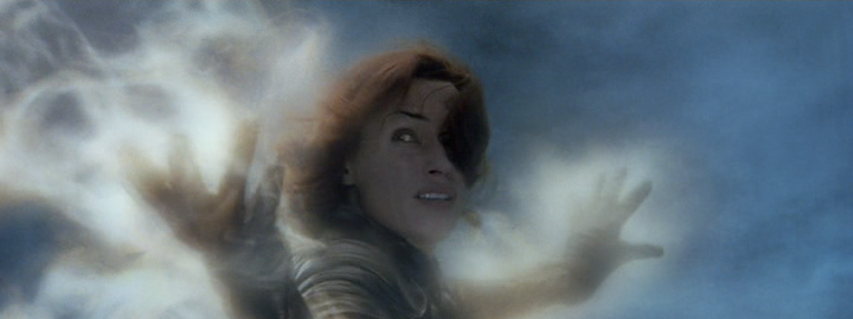
As she finally accepts this new power she’s been given, her entire body erupts into flames, and a sort of serenity overcomes her as she drops her arms and lets the water take her.


The X-Men are safe. Jean Grey is dead.

Or is she?

The final shot of the movie has us moving over the serene waters of Alkali Lake (now a river, I suppose) as Jean’s voice repeats the monologue from the opening of the first movie. And as the music swells, we see a flaming, birdlike figure just beneath the surface of the water.


“...every few hundred millennia, evolution leaps forward.”


So… what do
you think X-Men 3 was supposed to be about?

Obviously, this was all leading up to an adaptation of Chris Claremont and John Byrne’s
Dark Phoenix Saga, arguably the most revered storyline in X-Men history. But how could Singer & Co. translate that space-faring epic to the screen while keeping the somewhat grounded tone of the existing movies? To my mind, it was a simple matter of evolution.

Rather than the voracious cosmic entity which possesses Jean Grey and drives her to consume worlds in the comics… or the disturbed multiple-personality that Xavier locked away in Jean's mind in an attempt to keep her from abusing her enormous gifts in Brett Ratner’s
X-Men 3… the story could have been about evolution. The radiation from Magneto’s machine causes Jean to evolve far beyond any normal mutant, into something with so much devastating potential it puts the whole world at risk.

With this thought in mind, I went searching the web to find out if it had ever been revealed just what Singer’s plans for the third X-Men movie were. Surely, I wasn't the first person to connect these dots, was I?

I wasn't. To my delight, the plans for Singer's third movie had been revealed, and they were even more ambitious than I could have guessed.

I was right about one thing, though… Evolution was the key.

Here’s an excerpt from David Bentley’s blog
The Geek Files (full article HERE):

Author Thomas McClean's book Mutant Cinema: The X-Men Trilogy From Comics to Screen answers some of the questions raised by fans, who have been desperate to find out what Singer and his own writers Dan Harris and Michael Dougherty had been planning for their unmade version of the third film.

Dougherty had already revealed some time ago that they had wanted to cast Sigourney Weaver as Emma Frost, a comic book psychic who would be reimagined as an empath able to control people's emotions. Some reports have suggested that Frost would have been an old flame of Xavier and would have emotionally manipulated a resurrected, unstable Jean Grey into the evil Dark Phoenix.

McLean's book adds new information:
Dougherty says the resolution of the Phoenix plot would definitely have been a major part of their version: "The main element for me was Jean coming back and learning how much power she could wield - that she just became overcome by it."

Dougherty says that many of the ideas he was considering, such as Magneto trying to use Phoenix as a weapon, ended up in the filmed version. He also says that the idea of Jean using Cyclops' power to kill herself was one they liked, though they would have made it clear that only Phoenix's body was dying. Her spirit would live on, evolving Jean past mutant and into a godlike cosmic state.

Dougherty likens it to the closing lines of Arthur C Clarke's novel
2001: A Space Odyssey in which the Star-Child that was astronaut David Bowman hovers over the Earth: "Then he waited, marshalling his thoughts and brooding over his still untested powers. For though he was master of the world, he was not quite sure what to do next. But he would think of something."


For more detail on the plot and character arcs (I’ll give you a hint: Cyclops doesn’t die in the first act), check out Bentley’s other blog post
HERE.


So there you have it. A far more faithful adaptation of the Phoenix story, and what’s more, a somewhat risky direction to take the third film of a popular franchise. From Chris Claremont to Arthur C. Clarke. From WWII to the cosmos. Singer's X-Men films were always pushing the boundaries of what you'd expect from a comic book superhero movie. Proving that truly ambitious storytelling was not precluded by the presence of a dude with knives in his hands.

Taking this into consideration, I have no doubt he could have pulled off his vision for the third film successfully. To me, Bryan Singer is still the best thing to ever happen to comic book movies.


Here’s hoping he makes another one some day soon.

Tuesday, May 25, 2010

Evolution: Bryan Singer's X-Men 1, 2, and 3 (Part 1)

As news of the current events in the X-Men universe floods the web, I’ve found myself in a very X-centric (heh) headspace. When not scouring the message boards for vicarious thrills in the reactions and opinions of those experiencing the comics firsthand, I’ve been digging up my old collection of X-books to revisit the bygone glories of yore.


(...what the hell did I just say?)


If I could, I would just break down and buy the latest comics myself, but the
Big Move looms ever closer, and every penny saved is to be treasured.

This past Sunday, my obsession culminated in a miniature X-movie marathon, wherein I watched the first (best) two X-films:
X-Men and X2: X-Men United.


(are you sick and tired of the letter X yet?)


I’ve always enjoyed both movies, though I consider X-Men to be almost an audition tape -- a proof of concept -- for what Singer would achieve in the far superior X2. The first movie is like the first season of an ambitious TV show (season 1 of Buffy the Vampire Slayer comes to mind). It has all the right components, but is still figuring out how to use them to best effect.


X-Men featured a talented cast, a skilled director, an interesting story, and -- something movie studios were only just figuring out at the time -- a healthy respect for the source material that made the movie worth making in the first place. What it lacked, in my eyes, was confidence. The filmmakers knew they had something special on their hands, but also knew they had two masters to serve, each with very different expectations. There was the movie studio, who wanted a tight, entertaining, accessible action flick for the masses, and there was the comic fanbase, who wanted to see their beloved characters brought to the screen faithfully.

Singer and company achieved what seemed impossible at the time, satisfying the demands of both… but the signs of their struggle still showed around the edges. Action scenes were a little too self-conscious to be taken seriously, and edited a little too stiffly to be believable. The quiet, character-building scenes that Singer had shown a mastery of in both previous and subsequent films were edited down to quick, concise exchanges which served only to move the plot forward. The detail and nuance was there, but it was left largely implied. The entire movie is filled with scenes that you enjoy, but wish there was more of. As though something truly special is lurking just on the other side of the cut. 


(In the special features of the X-Men 1.5 DVD, we actually see some of these lost and extended moments, and a part of me wishes we could get an extended edition of the first movie, Lord of the Rings style, just to see these scenes edited into it, regardless of pacing. Sometimes, you just wanna watch the characters talk.)

The movie's plot never quite overcame a small air of stereotypical comic cheesiness, but the weight of the subject matter and characters helped to keep it grounded.

Ultimately, we're given something that satisfies on the basic principals of good storytelling, but does not yet show the chemistry of a truly great film.


That we got with X2.


Here, Singer knew exactly what he was doing, knew exactly where he could go, and went there, and beyond, with the confidence and skill of a master. X-Men was a good movie. X2 was something great. A continuation and expansion of the themes and plotlines of the first film, but with the commitment and assuredness the first film lacked.


Here, there is no rush. The quiet character moments are not only left in, they make the movie. Hell, if not for those moments, one of the most important and relevant characters might have been cut entirely, his storyline lost, and so, the deeper conflict and questions the films sets out to ask, lost as well.

The tone was darker, all pretense of “comicky” flash and dazzle abandoned. This movie was a serious science fiction adventure film. Though not without its moments of levity and humor, it never made fun of itself, never winked at the audience. It took place in a real world which only lent weight and believability to the fantastical exploits of its protagonists.

This is why X2 is a great movie.

But what made it a great X-Men movie is that little something extra. Again, a respect for the source material, not only on the superficial level that movies like Spider-Man, Sin City, or Hellboy managed, but in the deeper spirit of the material. The allegory, the world-view, the interpersonal relationships and small details that only fans of the comics would notice. The stuff that made the comic tick was there on the screen, invisible to all but the few who would appreciate it


X2 was such a great flick…


Then came X-Men 3.


...whoof… did it just get chilly in here…?


Contrary to popular belief, X-Men 3 (or X-Men: The Last Stand) was not a bad movie. It was a solid action flick, at times plenty of fun, that took a lot of those aforementioned superficial elements from the comics and plastered them all over the screen in a story that, based on its own merits, was structurally tight and formulaically satisfying. This does not a bad movie make.

But it was disappointing. Because what had come before had aspired to so much more that, well… audiences didn’t want just a fun action movie. They wanted their serious science fiction saga. They wanted greatness again.

To me, X-Men 3’s largest failing is its near-complete ignorance of the thematic elements that Bryan Singer had built into the series since the very beginning. Not the themes of tolerance or feeling like an outcast -- all of that was covered, though in a way that left many dissatisfied with the message it was sending.

I’m talking about the theme that Singer hands us as the very first words spoken at the very beginning of the first movie…

“Mutation. It is the key to our evolution. It is how we have evolved from a single-celled organism into the dominant species on the planet. This process is slow, normally taking thousands and thousands of years. But every few hundred millennia, evolution leaps forward.”

And that, dear friends, is the story of the X-Men movies. The underlying theme, which Bryan Singer even reiterates to us in the final moments of the second movie, and which Brett Ratner and his team were either unwilling or unable to carry through in the third… Evolution.


~*~*~*~


Be sure to check back for Part 2, wherein I descend to levels of nit-picky geekdom the likes of which no person in their right mind would ever want to subject themselves to...


Wait, that's a horrible teaser.


Be sure to check back for Part 2, wherein I am awesome!


See you soon.